 Connect
Subscribe to Working Visually on LinkedIn to get the newest monthly edition delivered straight to your inbox!
Change management often fails for a common reason: people cannot become what they cannot see.
We have all seen the binders. The hundred-page strategy decks. The "all-hands" emails that explain a new direction in dense text. But when leaders rely solely on words to drive transformation, they can’t be confident everyone absorbed the message. If teams take away varying priorities from leadership initiatives, misalignment creeps in.
Successful change requires a shared reality. Based on the leading research from centers of expertise like Harvard and Wharton, we can boil down successful change management to 9 steps. At Throughline, we believe every single one works better when you visualize it.

The first hurdle is inertia. To get moving, you need to Establish a Sense of Urgency. A memo about "market headwinds" is easily ignored. A visual map showing competitors encroaching on your territory? That creates a visceral reaction. It turns abstract data into a visible threat.
Once the fire is lit, you need to Form a Guiding Coalition. Don’t just list names on a spreadsheet. Visualize your internal network. Draw the lines of influence to see who connects the C-suite to the frontline. This visual roster helps you see if your coalition has the actual reach to drive the effort.
Then comes the Vision and Strategy. This is your North Star. If your vision is a paragraph of corporate jargon, it will not stick. If it is a literal picture of the future state—a destination everyone can look at—it becomes tangible. It transforms a "to-do list" into a journey. Make it an interactive visual and the impact amplifies further.
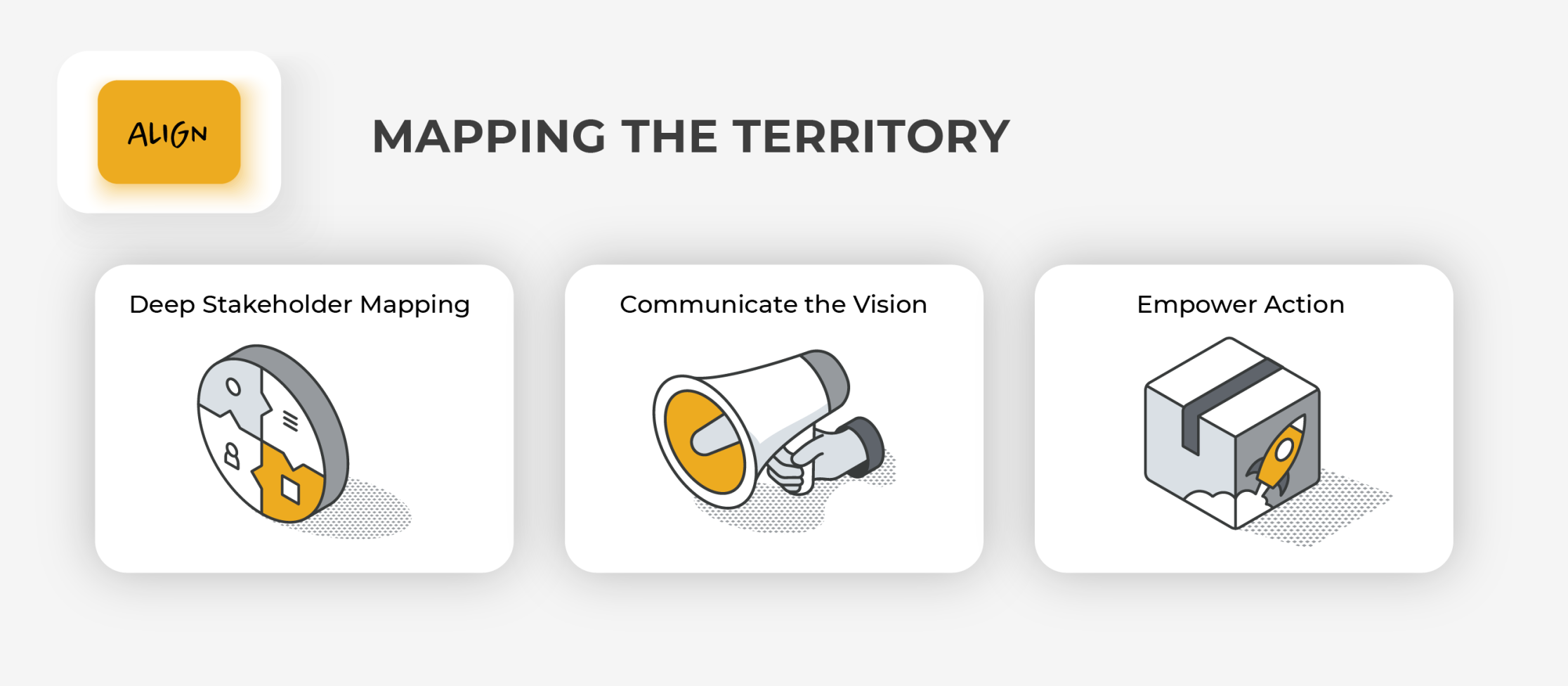
Teams cannot navigate new terrain blindly. Deep Stakeholder Mapping is inherently visual. Plotting your people on a matrix of influence versus interest reveals potential allies, groups of friction, and where you need to spend your political capital.
With your map in hand, you must Communicate the Vision. In a world of data overload, visual storytelling cuts through the noise. Infographics and visual metaphors act as shortcuts for the brain, allowing complex ideas to travel faster than text ever could.
This clarity helps you Empower Action through process mapping. When you visualize your processes, the bottlenecks become obvious. You can see exactly where the barriers are—the obsolete systems or broken workflows—and remove them to clear the path.

Momentum is invisible until you measure it. Generate Short-Term Wins by creating visual scorecards. A progress bar or a journey map filled in as you go provides visual proof that the ship is turning.
As the journey continues, you must Provide Support and Resources. Visual frameworks and playbooks are far more effective than text manuals. They give your team a mental model they can reference at a glance when they feel lost.
Finally, you need to Consolidate Gains and Institutionalize the Culture. Culture is often defined by its artifacts. The posters on the wall, the diagrams used in onboarding, the visual language you use in meetings—these symbols anchor the change. They remind everyone, every day, that "this is how we do things now."
Are you ready to draw your future?
If your strategy is stuck in a document, it’s time to set it free. Let us help you visualize the complex so your teams can execute with confidence and clarity.
'Til next time,
The Throughline Team
P.S. More of an auditory learner? Check out this talk on the science of change management by leading expert Paul Gibbons.



.png)
